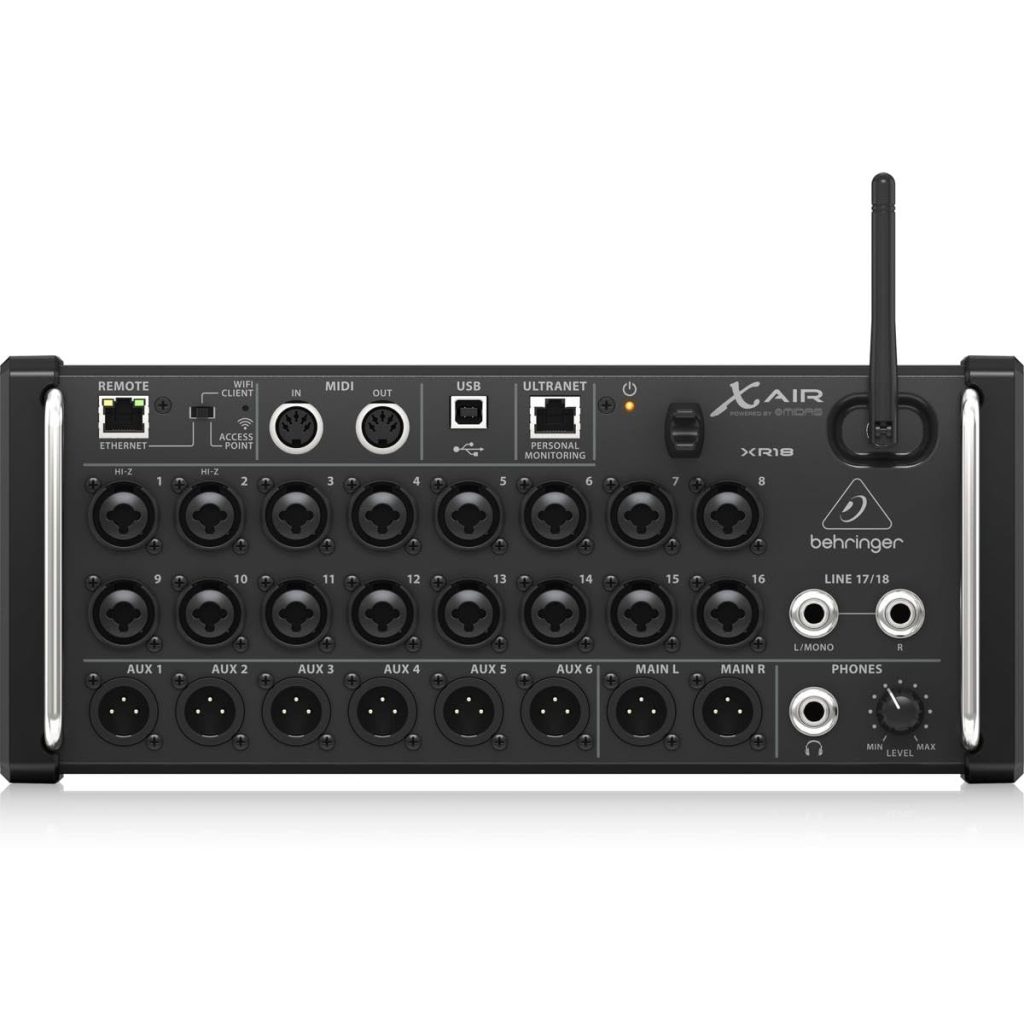
The Behringer X AIR XR18 is a digital mixer that has carved out a notable place in the live sound and recording world since its release. It’s a 18-channel, 12-bus unit designed to be controlled entirely from a tablet, which makes it a practical choice for situations where a traditional mixing console would be too bulky or impractical. The XR18 includes 16 programmable Midas-designed preamps, an integrated Wi-Fi module, and a multi-channel USB audio interface, all packed into a rack-mountable chassis.
In real-world use, this mixer is often found in small to medium-sized venues, houses of worship, rehearsal spaces, and even home studios. The ability to control everything from an iPad or Android tablet means you can walk around the room while adjusting levels, which is a significant advantage for live sound engineers who want to hear the mix from the audience’s perspective. The preamps are generally clean and transparent, handling a variety of microphones and line-level sources without noticeable noise. The built-in Wi-Fi module, however, is a point of contention. It works well enough in controlled environments with minimal interference, but in crowded Wi-Fi zones or larger venues, it can be unreliable. Many users opt to bypass the internal module and connect a dedicated external router for more stable performance.
Key functional features include 16 Midas-designed input preamps, 8 XLR outputs, 6 aux sends, 4 FX buses, and a stereo main bus. The mixer offers 4 internal effects engines with a range of reverb, delay, modulation, and dynamics processors. The USB audio interface provides 18×18 channels of recording capability, which is handy for capturing live shows or multi-track recording in a studio setup. The control software, available for iOS and Android, is intuitive and responsive, though the initial learning curve can be steep for those accustomed to physical faders and knobs. The app layout is logical, but navigating submenus for advanced settings takes some getting used to.
One significant limitation is the lack of physical controls on the unit itself. While this is by design, it means that if the tablet loses connection or the battery dies, you lose control of the mixer. This is a trade-off that users must accept. Additionally, the Wi-Fi range and stability are not always reliable, especially in environments with heavy wireless traffic. The plastic chassis feels durable enough for portable use, but it’s not as rugged as some metal competitors. The power supply is external, which can be a minor inconvenience for rack mounting.
Compared to a traditional analog mixer with similar channel counts, the XR18 offers far more flexibility in terms of routing, effects, and recallable settings. However, it lacks the tactile immediacy of a physical console. For those who prefer hands-on control, something like the Allen & Heath QU-16 or a used Yamaha LS9 might be more appealing, though they are typically more expensive and heavier. The XR18’s digital nature also means you can save and recall entire show setups, which is a huge time-saver for bands or venues that host multiple acts.
This mixer is well-suited for musicians, small bands, and sound engineers who need a portable, versatile digital mixer for live or studio work. It’s also a good fit for installs where space is limited. However, it is not ideal for those who require immediate physical access to controls without a tablet, or for users who need rock-solid Wi-Fi reliability without additional investment. Beginners might find the learning curve challenging, but the online community and available tutorials help mitigate this.
Overall, the Behringer X AIR XR18 offers a lot of functionality for its price point. It’s not without its quirks, particularly regarding wireless stability, but for many users, the convenience and feature set outweigh the drawbacks. It’s a practical tool that performs well in its intended use cases, provided you’re willing to work around its limitations.